Prefer to read offline? Download this article as a PDF
You sit down to complete the project you have been procrastinating on. Ding. You finally take your running shoes out of the closet and are just about to put them on. Ding. Finally, today is the day when you clear the clutter that has somehow manifested over your countertop. Ding. With every ding, you pick up the phone thinking you’ll quickly check it and get back to whatever it was that you were doing, but then hours go by, and you have procrastinated once again.
What Are Notification Distractions?
Notification distractions are the interruptions that come from alerts on your phone, watch or computer: a new email, a WhatsApp message, a social media update, a sale on Amazon.
The trouble is that each one feels like nothing. You check it quickly, and usually that is all. But one check turns into checking the other alerts too, then a quick browse, and an hour later you are somewhere unrelated, on a task that needed 30 seconds.
That is by design. Most apps are built around engagement: keeping you there as long as possible, and ideally getting you to act, like buying a lamp for a side table you do not own. Notifications are how they bring you back.
Why Willpower Fails
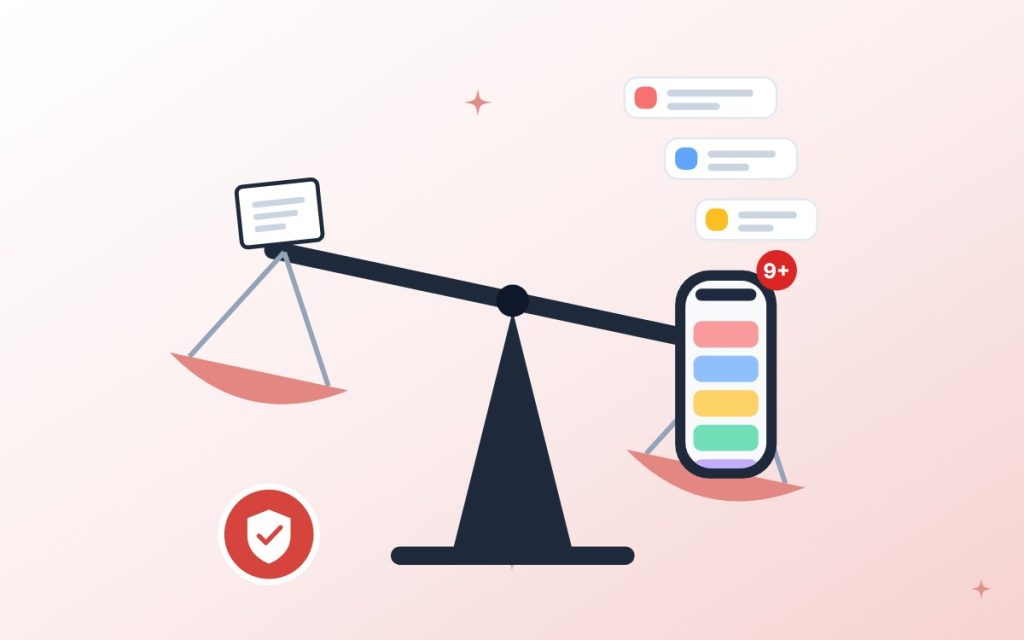
Being reachable all day sounds like connection, but it leaves little time that is your own, and willpower is one of the first things to suffer.
Here are a few reasons why willpower fails you:
- Notifications are designed to distract you. The wording, the timing, and sometimes the graphics are planned in advance for maximum engagement.
- Every notification promises a small reward, and over time you start to expect it. Checking becomes something you do before you have decided to, and the more you check, the more the habit asks for.
- Constant notifications and the habit of always being online also feed a fear of missing out. Either you are online, or you are wondering what is happening in the digital world, and both wear your willpower down.
Over time, when these habits continue, they chip away at your concentration. You are not able to practice deep focus, and after a while, even your willpower is not enough.
Protect Your Willpower From Notification Distractions
There is nothing wrong with staying connected, but you do not have to respond within seconds every time the phone buzzes. Here are a few things you can do:
Turn off non-essential notifications first. That usually means shopping apps and social media.
During deep work or working hours, put your phone on Do Not Disturb or a focus mode.
Another way to protect your willpower is physical distance: if your work allows, put your phone in another room for the hours you need to focus.
FocusMe takes the decision away: block the sites and apps behind the notifications for the hours you need, on a schedule or a timer. The app stays closed, so there is nothing to check; for the sound itself, use Do Not Disturb. It runs on Windows, Mac, Linux, Android and iPhone.
Conclusion
Technology has changed our habits. Being online all the time is now normal, even expected: friends wait for a reply to a meme, the family chat is planning a holiday, and work email arrives around the clock. When everyone can reach you, it is easy to stop being there for yourself. If notifications have worn your willpower down, the steps above get you out of the loop. Start with one, and keep at it.
FocusMe
Make the focused hour the normal one
Block the sites and apps that pull you off track, on a schedule or a timer, on Windows, Mac, Linux, Android and iPhone.
Start your free 14-day trialNo credit card needed.
FAQs (Frequently Asked Questions)
Why does willpower fail when we try not to check our phones?
Willpower fails when we try to avoid checking our phones because notifications trigger curiosity and quick rewards. When this continues over time, it creates a habit of constantly checking the phone, which is hard to resist.
What are notification distractions?
Notification distractions are interruptions caused by regular notifications you receive on your phone due to alerts, messages, emails, or social media updates. These notifications break your focus and shift attention away from important tasks.
How do notifications affect productivity?
Notifications interrupt concentration and force the brain to switch tasks. This reduces efficiency and makes it harder to return to deep, focused work.
How can I reduce notification distractions in daily life?
Turn off unnecessary alerts, use focus mode, keep your phone away during work, and schedule specific times to check messages instead of responding instantly.
First published
Want to talk it through? Join the FocusMe community