Prefer to read offline? Download this article as a PDF
Why Your Response to Expectations Can Help or Harm Your Productivity
Have you ever wondered why you respond to a request in the way you do? Do you ever question why someone won’t fulfill your request? Have you been told you ask too many questions, or wonder how others can convince someone to do something but you can’t?
Gretchen Rubin’s Four Tendencies framework is a popular way of answering questions just like these. It comes from her own observation and reader surveys rather than from tested psychology, so treat it as a useful lens, not a diagnosis. Still, how people respond to expectations has a lot to do with how quickly a task is accomplished, if at all.
If you’re on a quest to improve the way you work, understanding how you tend to respond to your own expectations and to the expectations of those around you is a critical first step.
The Four Tendencies: A Brief Overview
Gretchen Rubin is the author behind the Four Tendencies framework. Having relinquished her career practicing law to become a full-time author and human behavior explorer, Rubin discovered the Four Tendencies through asking a simple question: “How do people respond to expectations?”
After studying the material collected for her book Better Than Before, Rubin recognized a “balanced, consistent, encompassing, and predictive” system that sorts people by how they respond to expectations.
“It took me months of rumination to make sense of everything I’d observed, and to fit it into a system that accounted for everything,” recalls Rubin. “I’ll never forget the thrill I felt when everything at last fell into place.”
Knowing the answer isn’t the end result, though. On her website, Rubin explains that recognizing the answer to this question can be helpful in gaining cooperation from others, being persuasive, and, as you may have guessed, enabling yourself and your team to become more effective.
Rubin refers to her framework as a “Sorting Hat for Muggles,” referring to a similar, fictitious categorization from the Harry Potter book series. Though each individual may share characteristics of more than one Tendency, there will always be a dominant mannerism each person defaults to.
And it’s the differences, however minor they seem, that are the most important to recognize when discovering your unique Tendency and how to use it to your advantage.
The Basic Framework of the Four Tendencies
Rubin’s months-long research and rumination led her to discover that every person fit into one of four Tendencies: the Obliger, the Rebel, the Questioner, and the Upholder. The Tendencies are referred to as such because they describe the way people tend to respond to expectations placed on them by others, or by themselves.
“If we don’t know our Tendency, or someone else’s Tendency, we may pursue strategies that are ineffective, or worse, counterproductive,” says Rubin.
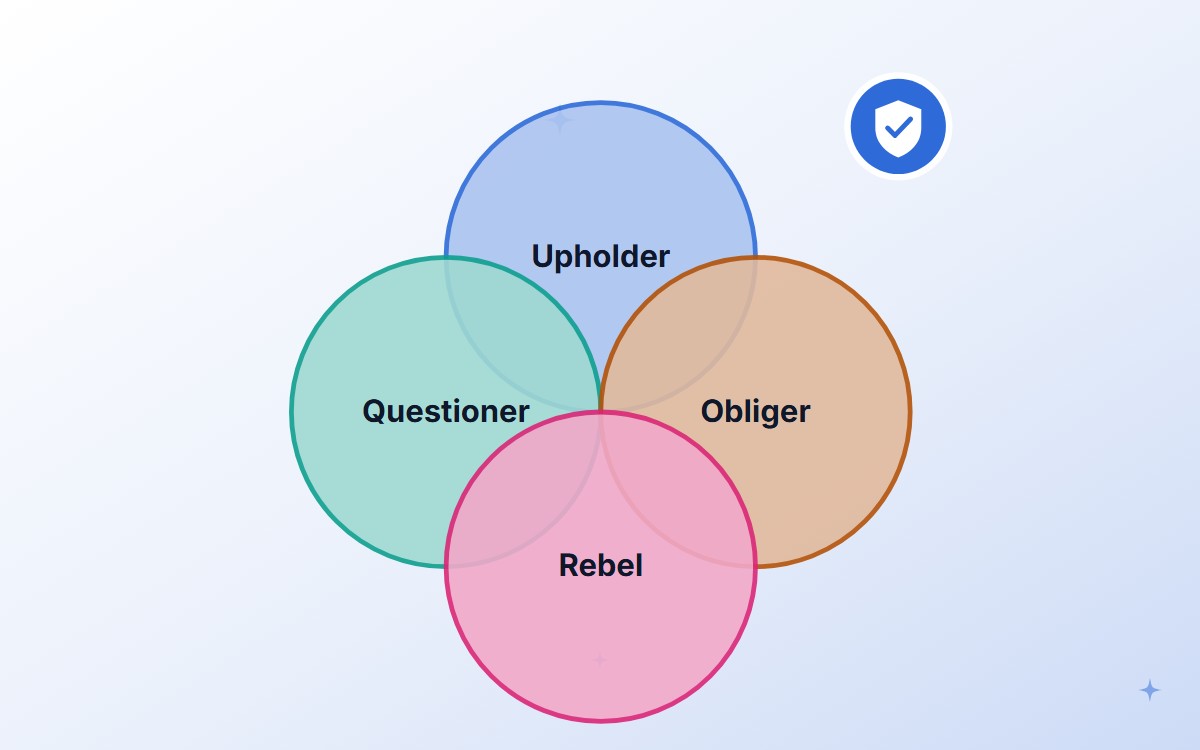
The Tendencies aren’t meant to describe the way a person always responds, but rather their most common go-to mode. Thus, Rubin reiterates that those who discover their Tendency should not pigeonhole themselves into their specific profile, but learn how to use it to their advantage.
To reveal a person’s core Tendency, Rubin developed a quiz that hones in on how a person behaves when presented with an expectation. The types of expectations she explores are lumped into two categories: outer expectations and inner expectations.
Outer expectations include deadlines, work-related demands, or a spouse asking you to complete a chore. Inner expectations are those we place on ourselves, such as goal-setting, maintaining a New Year’s resolution, keeping up with your blog, or graduating.
“…Part of what made the quiz tricky was that I had to figure out questions that would really pinpoint the key differences among the Tendencies,” explains Rubin.
“Your response to expectations may sound slightly obscure, but it turns out to be very, very important.”
Let’s learn a little more about the four Tendencies Rubin discovered:
The Obliger
When examining the response to inner and outer expectations, the Obliger excels at meeting outer expectations but will resist inner expectations.
In simpler terms, this Tendency is more of a “people pleaser” that wants to meet others’ expectations and is willing to sacrifice their own ambitions.
If you’ve ever wondered why other people are able to rely on you but you aren’t able to meet your own goals, you might be an Obliger.
Obligers are the largest group: 41% of the people in Rubin’s survey. Their risk is burnout. Pushed too far, Rubin says, an Obliger can reach “Obliger-rebellion” and abruptly refuse to meet an expectation, which can be as small as turning up late or as large as quitting a job or ending a friendship.
The Questioner
Questioners question all expectations. They will meet one, from a boss or from themselves, only if they believe it makes sense, so in effect every expectation has to become an inner one first.
A Questioner who is convinced has no trouble following through. What they resist is anything that looks arbitrary or inefficient, and they are unlikely to settle a matter while their questions remain unanswered.
The Rebel
Concerning inner and outer expectations, the Rebel resists them both.
If you ask or tell a Rebel to do something, they are likely to resist, and that includes things they tell themselves to do. It is not about you: being told to is the problem.
Rebels value freedom, choice and being true to themselves. In Rubin’s words they want to do what they want, in their own way, on their own time, and they would rather choose to do a thing than be expected to.
The Upholder
The fourth Tendency is the one Rubin herself identifies with: the Upholder. Upholders embrace both outer and inner expectations. They don’t want to fail others, but they don’t believe in failing themselves, either.
Because Upholders feel the need to satisfy everyone (including themselves), they tend to be better at forming good habits that will help them achieve others’ expectations while still finding the time and strength to meet their own goals.
Which Tendency Do You Identify With?
At first glance, it may seem obvious which Tendency you most identify with. Rubin herself admits that these four Tendencies are largely self-explanatory. They overlap each other in many ways, especially when considering these are just “tendencies” and not a strict label that each person adheres to 100% of the time.

The quickest way to find out is to take Rubin’s quiz for yourself. It is free.
A few things to know prior to taking the quiz:
The questions asked during the quiz require you to imagine yourself in various scenarios and select how you would most likely respond.
Understand that whatever the result, it does not mean that it’s your only way of being. The Tendencies do overlap, and you likely share characteristics of more than one Tendency.
The questions were specifically designed to break through that overlap to determine your true Tendency.
At the end of the quiz, you’ll get more in-depth information into your specific Tendency. The best thing you can do with this new information is to start putting it to work in your favor.
How Your Tendency Affects Your Ability to Work
Once you know if you’re an Obliger, a Questioner, a Rebel, or an Upholder, it’s time to learn how it affects your work ethic, and how you can start forming the right habits to improve it:

The Obliger
As someone who always puts others’ expectations in front of their own, the Obliger is often the first person co-workers or bosses turn to when they need a favor. Managers may have higher expectations of Obligers because they know Obligers will do whatever it takes to achieve them. Obligers may often be the leader of the group in school projects or work teams because others can depend on their reliability.
Being an Obliger can have both positive and negative effects on your productivity.
On the plus side, it means you’re unwilling to miss deadlines, which encourages you to maintain a productive schedule. You feel that not meeting the expectations placed on you is a symbol of failure, and you would do anything to avoid that designation.
On the downside, being an Obliger means you’re prioritizing other people’s expectations ahead of your own. You may not be allowing yourself enough time to create your own projects, pursue your own passions, or develop new interests. You may find it hard to turn down extra assignments from your boss, or say no to co-workers who ask for help. You feel it is your duty to satisfy others first, and to look after yourself with whatever is left over. So if you’re trying to write a novel, maintain a blog, create a piece of art for your home, or fix that leaky faucet once and for all, there’s a reason why you just can’t seem to get it done: other people’s expectations are more important to you than your own.
The Questioner
If you identify as a Questioner, you probably have no trouble keeping pace with goals you believe in. The trouble starts with a deadline or a rule that nobody has explained.
But it’s not that you don’t understand the importance of these things. It’s that you need to know what’s in it for you, and why things are the way they are in order for you to get on board.
You have a natural tendency to question the validity of deadlines, rules, and general information. You don’t like to wait in line because you don’t understand why you have to wait. Rather, you think that something could be done to avoid wasting time in line. Rubin once said to a Questioner: “Maybe you aren’t meeting your deadlines because you aren’t convinced they are really true.”
Questioners become so wrapped up in trying to see logic and reason in a project or task that they spend more time mulling it over than actually working on it. They need to see purpose. They want to know how they will benefit in the end. They want to view the problem from every possible angle.
Granted, there’s nothing wrong with wanting to be thorough. But being as thorough as a Questioner could cost more time than the problem is worth.
The Rebel
Rubin mentions that Rebels are the smallest group of the four tendencies.
Rebels tend to resist inner and outer expectations. They like to find their own way to do things. They want to do things on their own schedule.
This rebellion can cause problems when trying to improve productivity.
Rebels will spend more time thinking about how they can change a system instead of abiding by the rules. They’re more concerned with doing things their own way instead of taking the easy way. If someone asks them to do something, they will decline or delay any action, even if they had been planning to do it before they were asked.
The Upholder
Upholders respond readily to outer and inner expectations. They do what is asked of them and what they have promised themselves, usually without much fuss.
Upholders don’t want to let anyone down, including themselves. They will stay up late, skip lunches, or come in early in order to complete any requirements.
But the strength has a cost. Rubin notes that Upholders can find it hard to step away from a routine or adjust when a schedule changes, which can make them seem rigid, and that they may feel compelled to meet an expectation even when it has stopped serving any purpose. For an Upholder, the productive question is not “how do I get this done?” but “does this still need doing?”
What to Do Next?
Rubin has mentioned in several interviews and published pieces that knowing your own Tendency and the Tendencies of others can be helpful in a variety of situations. She has heard personal success stories from people who have lost weight, from parents who prevented their child from dropping out of school, from doctors persuading patients to take their medication as prescribed, and from employees who want to work better as a team.
You can use your Tendency to help develop habits that work well for you. For example, if your goal is to visit the gym more often, an Obliger might want to rope in a workout buddy, because they wouldn’t want to let someone down by canceling a workout.
It can be helpful to understand someone else’s Tendency and know how it affects you. If you want them to do something, such as helping on a project at work or meeting a specific deadline, you’ll know the best way to get them to respond.
Whatever your Tendency, FocusMe can turn an inner expectation into an outer one: you set the rule once, and the software holds you to it, on your computer and your phone. Obligers in particular may find that a block set in advance does what a to-do list never could.
Take the first step by discovering your own tendency. Once you know what makes you tick, you’re better positioned to influence yourself and others around you.
FocusMe for students
Study without the tabs that eat the evening
Block the sites and apps that pull you off a study session, on a timer or a schedule, on your laptop and phone.
Start your free 14-day trialNo credit card needed.
FAQs (Frequently Asked Questions)
What are Gretchen Rubin’s Four Tendencies?
Upholder, Questioner, Obliger and Rebel. The framework sorts people by how they respond to outer expectations, such as a deadline, and inner ones, such as a resolution.
How can the Four Tendencies improve productivity?
Knowing your Tendency tells you which kind of plan you will keep. An Obliger needs someone or something to answer to, a Questioner needs the reason, a Rebel needs a choice, and an Upholder needs a clear plan.
Why do Obligers benefit from accountability?
Obligers meet outer expectations and struggle with inner ones, so a goal only they know about tends to slip. A workout partner, a deadline someone else is waiting on, or a block set in advance turns the inner expectation into an outer one.
What helps a Rebel get things done?
Choice. Rebels resist being told what to do, even by themselves, so a list of options to pick from works better than a schedule, and so does tying the task to the kind of person they want to be.
Is the Four Tendencies framework scientifically proven?
No. It is a popular framework built from Rubin’s own observation and surveys, not a validated personality test. Use it as a prompt for thinking about your habits.
First published
Want to talk it through? Join the FocusMe community