Prefer to read offline? Download this article as a PDF
Cal Newport’s book Deep Work gave a name to something most of us already suspected: that the hours we spend half-working, with a feed open in one tab and a chat in another, barely count. Keep an honest tally of your week and the amount of time lost to shallow work is startling.
Newport’s shallow work is the logistical kind: email, forms, scheduling, the tasks anyone could do. But the work that should be deep often ends up shallow too, because of the conditions we do it in:
- Other people are around and available
- Music is playing
- Several projects are open at once
- You are somewhere noisy, like a coffee shop
The Masters of Deep Work
The disappointing thing about working under those conditions is how little of it matches the image. We picture the productive writer or coder as someone who thrives on noise and caffeine and juggles three things at once. The people who actually produce the work are closer to the opposite: somewhere quiet, with one thing in front of them, and no way out until it is done.
Every teacher has met the student who asks for tips on learning the material. First question: did you read the assigned chapters? About half say no. Well, then go and read the material. And if they did read it, under what conditions? Half an hour, music on, while everyone else in the room watched a film. Anyone who thinks they can learn anything like that is either kidding themselves or a very rare breed.
Music off, no distractions, and you read the material until you get it, however long that takes. Classic. Rugged. Disciplined. It was true a generation ago, and it is true now.
You Need to Work to Get Stuff Done, and You Need to Work Deep
Nothing about that has changed, except that we now pretend it has. It is in the quotations we post and in the “everything will be fine” talks we give to friends, which we somehow forget to give ourselves.
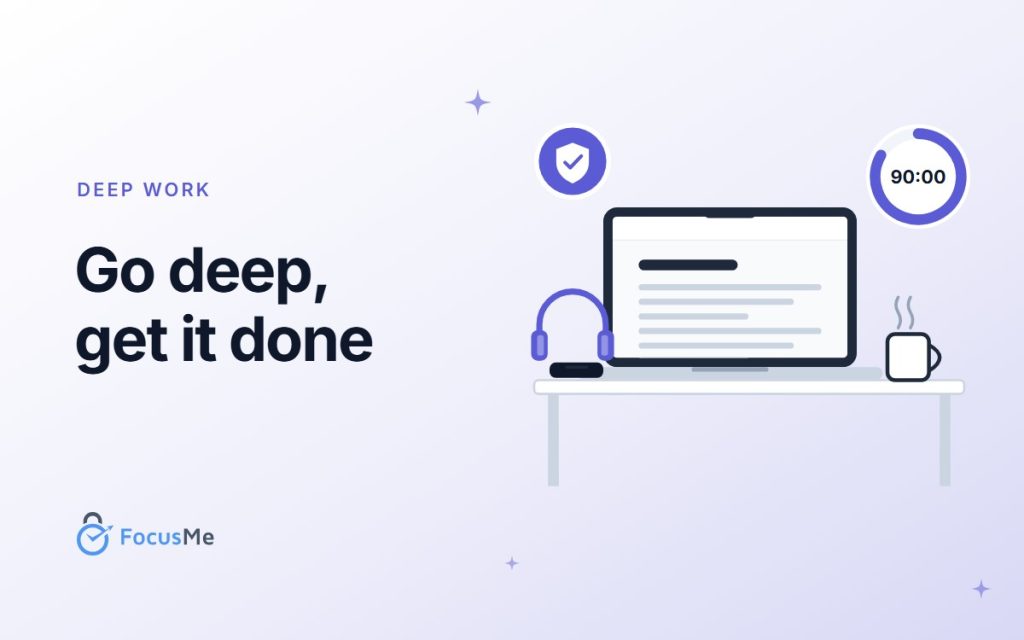
You need to work to get stuff done. And to work better, and faster, you need to work deep. Here are a few ways to do that (and a website blocker like FocusMe takes care of the screen side for you, so you don’t have to rely on willpower).
FocusMe
Block the sites and apps that pull you off track, on a schedule or a timer, on your computer and phone.
Try it free for 14 days
Measure Your Deep Work First
Before you change anything, find out where your day really goes. Shallow work is the logistical stuff anyone could do: answering email, scanning documents, typing numbers into a spreadsheet. Deep work is what takes your full attention and your skill: making sense of those numbers, writing the report, planning the project.
For one week, don’t try to improve. Just keep score of three things each day:
- How much time, in total, you spent on real deep work.
- Your longest stretch of deep work without an interruption.
- How many times you switched to something shallow, like checking email or making another coffee.
Most people are surprised by how little deep work they do. Once you see it written down, it’s much harder to fool yourself, and keeping the score week after week shows you whether you’re getting better.
The full exercise, and the four strategies that follow it (habits, running your day like a business, learning to love boredom, quitting social media), are in Why You Need to Do Deep Work.
Turn Off the Music
Yes, even music without lyrics. Some people can get into the zone with instrumental post-rock or a bit of classical, some of the time. More often it is a way of kidding yourself: you drift off with the track, or you spend so long choosing the right music for your mood that choosing becomes the activity, like spending so long looking for something to watch on Netflix that you could have watched an episode in the meantime.
The best music for deep work is silence. If you really must have something on, our guide to the best music for office productivity covers what works and what doesn’t.
Get Some Alone Time
Other people are the most reliable distraction there is. Not because they mean to be, but because a person who is available is a person who might talk to you, and some part of your attention stays on the door.
If you live alone, this is easy: shut the door and the world is gone. If you live with others, you need a room with a door, agreed hours, and a signal that means “not now”. A closed door and headphones (with nothing playing) do most of the work.
This is also a recommendation against going to public places to work, even a library. Some people manage it. If you are easily distracted, you need stronger defenses than a table in a busy room.
Uninstall FOMO and Be More Productive
It does not take much to talk most of us out of an evening of work and into an evening out. The fear of missing out is strong, and social media is built to keep it that way.
And yet the people who do sit down and focus remember the deep satisfaction of finishing a thing. If completing an article or sticking to a training plan feels that good, imagine finishing the book, or the product, or the degree.
Perhaps we need to stop fearing missing out on the small things and start fearing missing out on the big ones.
FOMO is an app that social media installed on you without asking. Uninstall it, and install FocusMe instead.
Take Breaks From Focus, Not From Distraction
Deep work is boring next to a feed, and if your mind is used to constant switching, focus will feel hard at first. It’s a skill, and it builds with practice.
That’s why one internet-free day a week doesn’t do much: six days of distraction and one day off is like eating junk food six days a week and calling Saturday your diet. Flip it around: decide in advance when you’re allowed online, write those slots down, and stay offline outside them. Distraction should be the exception, not the default.
It helps to tie your deep work to a fixed cue. Start the hard task straight after breakfast, before you open anything else, and keep the reward for afterwards. A Weekly Schedule in FocusMe can hold those offline hours for you, so the rule doesn’t depend on willpower.
Overestimate the Time Required
Some people can get small things done in the gaps between big projects. Most of us cannot. Deep work needs time before the task to prepare for it mentally, and time afterwards to come down from it, and it does not fit neatly between a meeting and a phone call.
So the next time you think you need thirty minutes to research a topic, or an hour to finish a piece of work, double it. The worst case is that you finish early and move on to the next thing, or take some much-needed quiet time. Underestimate it and you find yourself nearly done and panicking as the next appointment bears down on you, which is the opposite of deep work.
The Reward of Focus
Do all of this and what’s your reward? Tunnel vision. Singular focus. Getting into deep work mode is hard, but every time you remove an obstacle to it, it comes quicker, until a settled hour of real work is the normal shape of a morning rather than a rare event.
FocusMe can’t block a friend from knocking on your door, but it can keep you off the music and block everything except the apps and websites you need for as long as you set. It can also keep you off Facebook and the illusion that everyone else is living an amazing life while you miss out on it (they are mostly scrolling too).
Download FocusMe, get into deep work, and see what you can finish.
FocusMe
Make the focused hour the normal one
Block the sites and apps that pull you off track, on a schedule or a timer, on Windows, Mac, Linux, Android and iPhone.
Start your free 14-day trialNo credit card needed.
FAQs (Frequently Asked Questions)
What is deep work?
Cal Newport’s term for work that takes your full attention and your skill, done without distraction: writing the report, solving the problem, learning the hard thing.
What is the difference between deep work and shallow work?
Shallow work is the logistical kind that anyone could do while half-distracted: answering email, scheduling, filling in forms. Deep work is what moves a project forward and cannot be done in fragments.
How can I establish a deep work routine?
Measure first: for a week, note how long you spend on deep work and how often you switch away. Then set fixed hours for it, somewhere quiet, with the door shut and the music off, and decide in advance when you are allowed online.
How long should I plan for a deep work session?
Longer than you think. Deep work needs time to settle into and time to come down from, so double your first estimate. If you finish early, nothing is lost.
How can FocusMe support deep work?
FocusMe blocks websites and apps on your computer and your phone for the hours you set, or blocks everything except the ones you need, so the offline hours you planned stay offline.
First published
Want to talk it through? Join the FocusMe community