Staying focused sounds simple until a distracting website is only one click away. You may sit down to work, open your browser and plan to spend the next hour on an important task. Then a quick visit to social media turns into scrolling, and suddenly your focused work session is gone. This is where the Website Blocker vs. Willpower debate becomes important for anyone trying to improve focus and productivity.
This raises an important question: Should you rely on willpower to avoid distracting websites or should you use a website blocker to remove the temptation?
The answer is not necessarily one or the other. Willpower helps you make better choices, while a website blocker can make those choices easier to maintain. FocusMe combines tools for managing digital distractions with structured focus routines, helping you create an environment that supports better habits.
What Is Willpower and How Does It Affect Focus?
Willpower is your ability to control your actions and resist something you want to do in the moment.
When you decide not to check social media while working, you are using willpower. When you close a distracting website and return to your task, you are also using self-control.
Willpower is important because you cannot block every distraction in life. However, relying on it constantly can become difficult.
Imagine working for several hours while having the option to check social media, watch a video or browse something unrelated every few minutes. Each time, you have to make another decision. That repeated decision-making can make it harder to stay focused.
This is why learning how to build self control is valuable. Stronger self-control can help you make better choices, while changing your digital environment can make those choices easier.
Why Willpower Alone Can Be Difficult
The internet makes information and entertainment incredibly easy to access. Your browser may give you access to social media, videos, shopping websites, news, games and countless other distractions.
Even with good intentions, temptation can appear when you are tired, bored, stressed or working on a difficult task.
You might think: I will just check this website for a minute. That minute can quickly become ten or twenty.
The problem is not always a lack of discipline. The distraction is simply easy to access. When you are already mentally tired, repeatedly resisting the same temptation can become harder.
This does not mean willpower is useless. It means willpower works better when you are not constantly forced to fight the same distraction.
What Is a website blocker?
A Website Blocker is a tool that prevents access to selected websites for a specific period or under certain conditions.
Instead of depending entirely on yourself to avoid a distracting website, you can create a rule that blocks access when you need to focus.
For example, you might block:
- Social media during work hours
- Video platforms during study sessions
- News websites while writing
- Shopping websites during focused work
- Gaming websites during scheduled focus periods
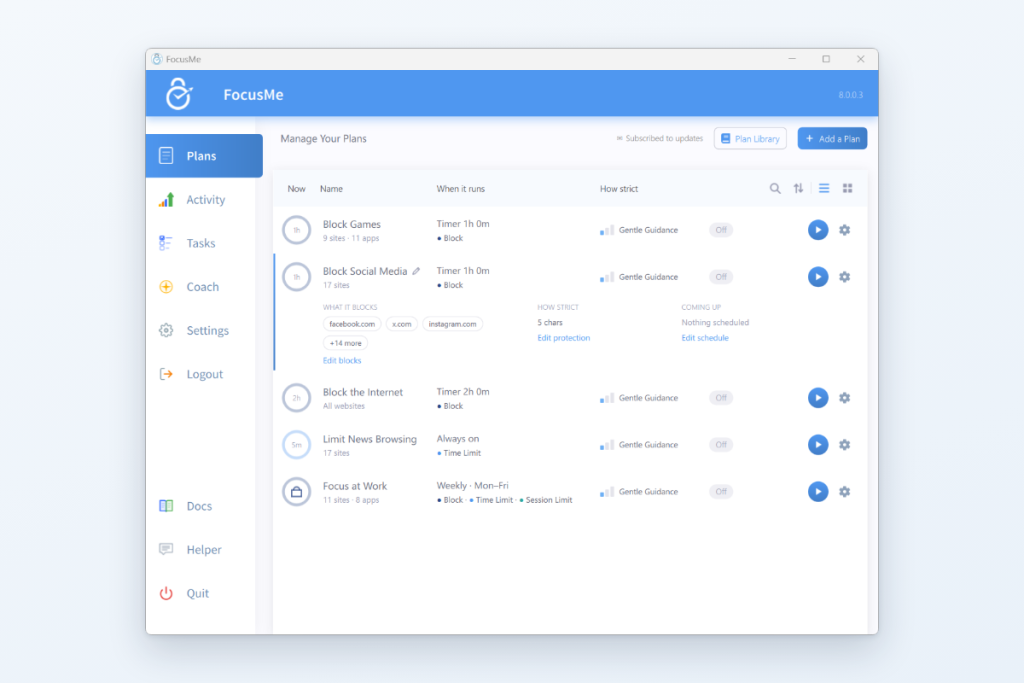
FocusMe provides tools for blocking distracting websites and apps, scheduling focus sessions, setting limits and creating routines around device use.

Website Blocker vs. Willpower: What’s the Difference?
The biggest difference is where the control happens. With willpower, you control your behavior when temptation appears.
With a website blocker, you reduce the opportunity for the temptation to appear in the first place.
| Willpower | Website Blocker |
| Depends on personal self-control | Creates an external restriction |
| Requires a decision each time | Can block access automatically |
| Useful in everyday situations | Useful for online distractions |
| Can become difficult when tired | Reduces repeated decisions |
| Helps develop personal discipline | Creates a controlled digital environment |
Can a website blocker Help You Build Self Control?
Yes. It can provide structure while you develop better habits.
Suppose you are trying to spend less time on social media. You could simply promise yourself not to open it while working. But that means making the same decision every time you feel the urge.
Instead, you can use FocusMe to schedule social media websites to remain blocked during your work session. The distraction is no longer available, so you can focus on your task instead of repeatedly resisting the temptation.
Over time, this can make focused work feel more natural. You may also find yourself reaching for distracting websites less often.
The goal is not to depend on blocking forever. It is to create conditions where better habits can develop.
When Should You Use a website blocker?
This blocker can be particularly useful when you repeatedly visit the same distracting websites despite knowing they are affecting your productivity.
It may help if you:
- Automatically open social media
- Lose track of time while browsing
- Check websites whenever a task becomes difficult
- Struggle to complete focused work sessions
- Need uninterrupted time for studying or writing
- Repeatedly break your own digital rules
A blocker is especially useful for tasks that require sustained attention, such as writing, studying, research, coding and creative work.
What a Blocker Can’t Do for You
A blocker removes the distractions that come from outside. But some distractions come from inside: habits, an unclear task or a day with no shape. With every distracting site blocked, you can still open random files, check your email again, switch between tasks or simply put off starting.
That usually happens when you sit down without knowing exactly what to do, or when the task feels too big. A blocker can’t fix that, but a little structure can:
- Start with one clear task. Not “I’ll work”, but “I’ll write 500 words” or “I’ll finish one section of the report”. Clarity removes the hesitation.
- Work in short blocks. Twenty-five minutes of work and a five-minute break keeps your energy steady and makes the task feel manageable.
- Keep your screen simple. One or two tabs, and no apps you don’t need for the task.
- Stay on one thing. Switching between tasks weakens focus. It feels slow at first, but staying with a single task gets easier with practice.
Put the two together and each makes the other work: the blocker keeps the easy escapes closed, and the structure gives your attention somewhere to go.
Why Combining Both Works Better
The most practical approach is often to combine willpower with environmental support.
Willpower tells you what you want to do. A Website Blocker helps make it easier to do it.
For example, you might decide to spend two hours writing. That is your intention. You can then use FocusMe to block social media, video websites and other known distractions during those two hours.
You still choose to work, but you do not have to repeatedly fight the temptation to open the same websites.
Start with shorter focus sessions and increase them as your ability to concentrate improves. This creates a routine that supports both self-control and productivity.
Final Thoughts
So, Website Blocker vs. Willpower: which actually works? Both have a role. Willpower helps you make intentional decisions and develop self-control. A Website Blocker reduces the distractions that can make those decisions difficult.
If you only occasionally get distracted, stronger habits may be enough. But if you repeatedly open the same websites despite wanting to focus, a blocker can provide useful structure.
You do not have to choose between discipline and technology. Use both together. Decide what deserves your attention, create boundaries around distracting websites and build an environment that supports the habits you want.
Ready to spend less time fighting distractions and more time getting important work done? Try FocusMe and create a digital environment that supports your focus.
FAQs (Frequently Asked Questions)
Is a website blocker better than willpower?
It can be more helpful when you repeatedly struggle with the same online distractions. Willpower still matters, but blocking distracting websites reduces the number of decisions you need to make while working.
Can a website blocker improve productivity?
Yes. Blocking distracting websites during focused work periods can reduce interruptions and make it easier to stay with an important task.
Does using a website blocker mean I have no self-control?
No. A blocker is simply a tool for managing your digital environment. It can support self-control while you develop stronger and more consistent habits.
How can I build self-control when my willpower is low?
Start with small, manageable habits. Create clear routines, remove unnecessary temptations and use tools such as FocusMe to make self-control easier to practice consistently.
Can FocusMe block specific websites?
Yes. FocusMe can be used to block distracting websites and applications and create scheduled focus periods, helping you limit the websites that most often interrupt your work or study.
Should I use a website blocker while studying?
If websites regularly interrupt your study sessions, a blocker can help. Blocking social media, entertainment or other distracting websites during study periods can make it easier to concentrate.
Can I still use willpower if I use a website blocker?
Absolutely. A blocker manages part of your environment, while willpower helps you follow your broader goals and routines. Using both can support more consistent focus habits.
What websites should I block while working?
Start with the websites you open most often when you are supposed to be working. These may include social media, video platforms, news sites, shopping websites or other sources of entertainment.
How long should I use a website blocker?
There is no single schedule that works for everyone. Start by blocking distracting websites during your most important work or study periods.
Can a website blocker replace self-discipline?
No. It is a support tool, not a replacement for self-discipline. It reduces unnecessary temptations so you can focus on developing better habits and making more intentional decisions.