Prefer to read offline? Download this article as a PDF
How many of your New Year’s Resolutions have you achieved?
*hears crickets*
That’s what we thought…
Now, here’s a method for setting goals that actually works:
As you may have gathered from the title of this article, at FocusMe we are not ashamed to admit our lack of neutrality in the New Year’s Resolutions vs Goals discussion.
- We’ve got an opinion.
- And we aren’t afraid to share it.
- New Year’s Resolutions Suck!
So why do we continue to make them?
A quick scan of the history books (AKA a single Google search) tells us that setting airy yet aspirational goals at the turn of the calendar year has been a popular activity since sometime between the dawn of civilization and the early 19th century, depending on your preference in specialist.
Despite that yawning gap in potential periods of origin and the added billions of resolutions that going by the earlier date would add to the tally, one thing we can say with certainty is that only around 45 of all the New Year’s Resolutions ever made have actually been achieved.
And all of those were made by one impossibly determined person.
- Obviously that’s a joke.
- Nobody is that different from you or me.
- But the people who get things done probably do set goals and then lay out a framework for how to achieve them.
Now, just to be clear: aim high, but keep it realistic.
To be fair to the calendar, a fresh start does help. Psychologist John Norcross and colleagues followed people who made a New Year’s resolution and people with the same goal who did not: at six months, about 46% of the resolvers had kept the change, against 4% of the non-resolvers (Norcross, Mrykalo and Blagys, 2002). The date is fine. The problem is what people resolve, and how.
Here’s how:
Block out the noise
Before you even get around to setting any goals, it’s crucial that you filter out all wispy day dreams and peripheral aspirations.
What is it that you really need?
And no, it’s not a romantic partner, a new car or to quit Facebook.
It’s true that these types of things may form part of your goals or even become the ultimate aim, but they tell you nothing about what you actually need to live a richer life.
- Love, the ability to move around safely and the need to escape the endless scroll on the other hand…
- Now, these are things that we all need.
Notice the difference between the first list and the second?
Lovers, cars and wanting to escape the endless scroll are all good and well, but they are just one potential way to solve deeper needs.
If you can’t define your needs and then prioritize them, you’ll never be able to set clear goals for how to meet them.
- And just in case the implied part wasn’t clear, chasing stuff for the sake of it doesn’t bring happiness or feed motivation.
- The best way to get something done is to have a good reason to want to do so.
- That’s why with this method of problem solving we start by identifying our underlying needs before even attempting to set any goals or, dare I say it, make any resolutions.

Using needs to identify goals
Of course, a need on its own is no more use to you than last year’s wishy-washy New Year’s resolution to shop locally even if it meant paying a little more.
But identifying what we really need, the things that would truly enrich our lives, gives us a foundation with which to begin setting the right goals.
- It can also help us to do something else important.
- It can help us to realize that we don’t always require the things we thought we wanted in order to fulfill our deeper needs, or that perhaps there is a different route to fulfilling those needs.
- Say you’re thinking of setting a classic resolution:
- You want to go the gym at least 4 days a week and lose X amount of weight this year.
- Those are pretty clearly defined, sensible goals, right?
- Sure, but even though they might help you to fulfill your fundamental need for good health, they are not the only way to do it.
- What about all the other ways you can get in shape and improve your mental and physical health?
- Never heard of anti-gravity yoga and water walking?
- Maybe the reason you never stick to the gym is because it just isn’t your thing?
- After all, we all know what they say about doing the same thing over and over again and expecting different results…
- So surely we’re better off just throwing a load of different stuff at the wall and hoping something sticks?
- In other words, once you’ve identified your needs the next step is to spend some time working out how they might be fulfilled.
- This means coming up with some kind of selection process to help you determine the most promising routes to success, or even a single goal that you believe will get you there.
- Yet even having a clear goal leaves you a long way off from actually getting anything done.
- Which is kind of the point of this article and our entire business.
Which leads us to…

The importance of setting micro goals
- Having a grand ambition or making a potentially life changing resolution feels fantastic!
- They can give our lives a real sense of purpose and meaning.
- But they can also be the cause of a unique kind of gnawing dread.
- The fear of failure.
- We all face it in some way or another on a daily basis.
- But when it comes to imagining big, important or long-awaited moments, this feeling can become particularly acute.
- What if you actually went after your dreams and didn’t realize them?
- What would you have left?
- This is doubtless an unnerving thought experiment, but in truth it’s not one we need to make.
- Your big goals are achievable!
- You just need to break them down into smaller micro-goals that seem closer and easier to accomplish.
This is how you create your framework for success.
One step at a time.
With realistic mini-objectives that give you something to grasp on to RIGHT NOW and help you to visualize a clear path towards your ultimate ambition.
That’s it.
A simple three step process:
- Identify your needs
- Work out how you can meet them
- Use micro-goals to help you get there
Turn your micro-goals into habits
The micro-goals that work best are habits you can measure, not results you hope for. “Write a novel” is a wish; “write 500 words a day” is something you can do today, and the novel follows.
Give each habit a fixed window, too. “Next year” leaves the door wide open to putting things off. “The next 100 days” is close enough to feel real.
A few more things that help:
- Start smaller than you think you need to. Take a bite you can manage, and take bigger bites once it feels easy.
- Pick one or two goals, not ten. Keep anything else small until the first habit runs on its own.
- Keep it quiet until you have progress to show. Announcing a goal can feel like an achievement in itself, and some research suggests that feeling makes people less likely to follow through.
- Start now. There’s no magic in 1 January. And if January has already slipped by, it isn’t too late.
- Expect it to feel hard at first. Most new habits are uncomfortable for the first few weeks, then become routine and stop needing willpower.
If your spare time keeps leaking into your phone, don’t go cold turkey: FocusMe can limit apps like Instagram or WhatsApp to a couple of short catch-ups a day, so the time goes to your new habit instead.
Our challenge to you this year is to put this process to the test.
- To try something different.
- And to never make another New Year’s Resolution.

Let FocusMe give you a helping hand
Let’s not sugarcoat it.
Even with a foolproof process, staying on track to achieve your goals can still be hard work.
That’s where a productivity app like FocusMe comes in.
If you struggle to maintain your concentration because of social media, gaming, news or any other form of digital distraction, these are the guardrails you need.
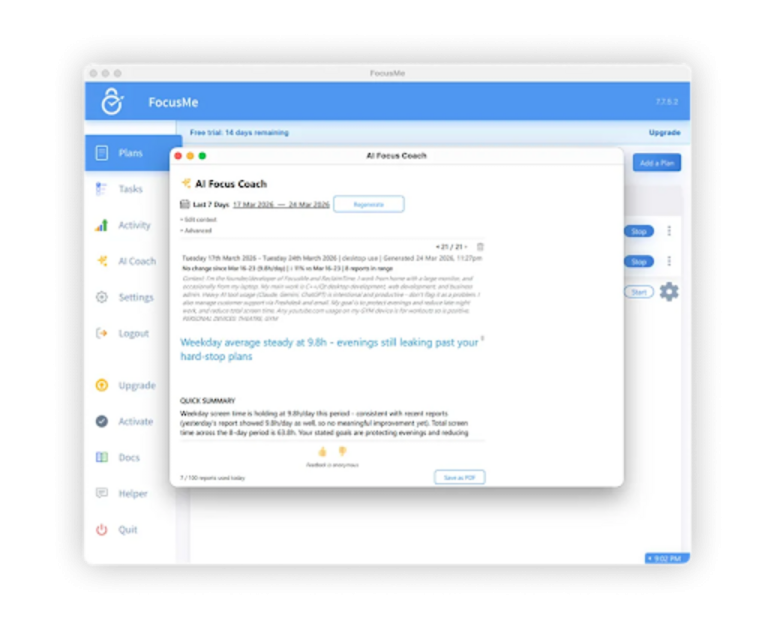
The app blocks the websites and apps you choose, on a schedule or a timer, on Windows, Mac, Linux, Android and iPhone, and holds the boundaries you set for yourself.
If you’re serious about improving your productivity, this is the tool that will help you to do it. Don’t take our word for it though.
Check out reliable third-party reviews by our many satisfied users to see what this one-of-a-kind tool can do for you.
If you’re ready to get serious about beating digital distraction, simply click the big shiny button below and we’ll guide you every step of the way!
Frequently Asked Questions
What is the difference between New Year’s resolutions and goals?
New Year’s resolutions are broad intentions or lifestyle changes, while goals are specific, measurable, and time-bound actions that lead to desired outcomes.
Why do most New Year’s resolutions fail?
Resolutions often fail due to being too vague, unrealistic, or lacking a clear action plan and consistent follow-through.
How can setting goals be more effective than resolutions?
Goals are more effective because they are specific, measurable, achievable, relevant, and time-bound (SMART), providing a clear path to success.
What are examples of common New Year’s resolutions?
Common resolutions include exercising more, eating healthier, saving money, reducing screen time, and improving work-life balance.
How can I turn a resolution into an actionable goal?
Make it specific and measurable. For example, instead of “exercise more,” set a goal to “work out for 30 minutes, three times a week.”
What strategies help in sticking to goals throughout the year?
Break goals into smaller steps, track progress, celebrate milestones, and use tools like reminders or accountability partners to stay on track.
Is it better to focus on one goal or multiple goals at once?
Focusing on one or two key goals increases your chances of success by allowing you to direct energy and attention without feeling overwhelmed.
How do I stay motivated to achieve my goals?
Connect goals to personal values, visualize the outcome, reward progress, and regularly review and adjust your action plan.
Can technology help me achieve my goals?
Yes, productivity apps like FocusMe can block distractions, track habits, and keep you focused on your goals.
What should I do if I fall behind on my goals?
Reflect on why you’re struggling, adjust your plan if needed, restart with small steps, and practice self-compassion to maintain long-term commitment.