Prefer to read offline? Download this article as a PDF
Tired of completely striking out every time you take a swing at lasting change?
Ever feel like a hidden law of gravity stands between you and those things you’ve always wanted but never found the willpower to claim?
Do you start every new attempt at transformation supercharged with motivation and energy?
Only to crash and burn after a few days of that enthusiastic action? And end up right back where you started?
For most people falling short of their aspirations (let’s face it, that’s most of everyone), this is all painfully familiar. And the worst part is you can spend an entire lifetime repeatedly setting the same exact big expectations but never getting anywhere closer to them.
Like a hamster wheel of underachievement sucking the hours away and leaving nothing substantial in its wake.
Discover How BJ Fogg’s “Tiny Habits” Can Transform Your Life
Sound Like You? It’s Time to Read the New York Times Bestseller, “Tiny Habits,” by BJ Fogg.
Fogg is a Stanford University behavior scientist who founded and directs the Behavior Design Lab (originally the Stanford Persuasive Technology Lab).
Fogg’s earlier work revolved around how computer technology can influence behavior, for better or worse. And how to design technology more ethically. This was the focus of his 2002 book, Persuasive Technology.
But over time, his findings led to insights for applying the same concepts to personal habit change.
And he began to drift more towards personal development teachings, especially regarding better health habits.
Learn more about him and his “Tiny Habits” work at bjfogg.com
The Method: Start With One Tiny Step
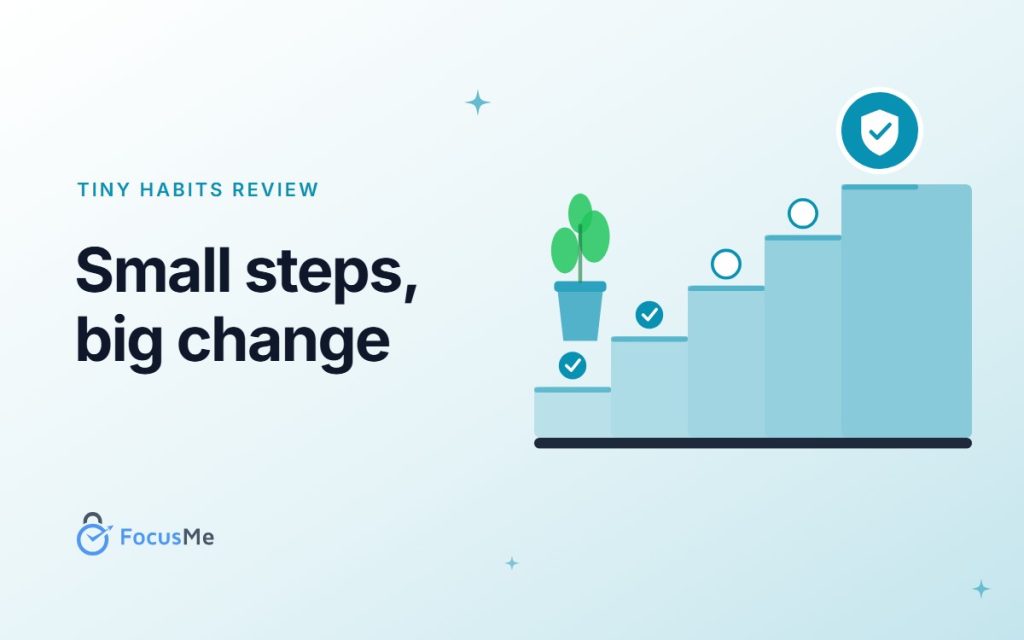
It’s a method that starts with one tiny effortless step…i.e. the tiny habit.
And then builds on that tiny step with another step, and then another.
It’s a methodology that (presumably) doesn’t require motivation, willpower, or long-term fortitude to get going and stay going…
(Which means it’s the perfect fit for “the rest of us.”)
And tiny habits naturally grow over time. Into transformations that drastically transform the landscape of your life.
By building one tiny (and I mean really tiny) habit, one upon the other. Until it piles up into a giant snowball of change, hurtling you towards the long-term outcomes you want.
Fogg’s Entire “Tiny Habits” Premise Revolves Around This Idea:
The easier a habit is to actually DO
The more likely you’ll actually do it enough for it to become habit.
This applies for both bad AND good habits.
So (as we’ve all experienced), we don’t just develop whichever new habits are best for us. That does provide some motivation (we’ll get to that), but the habits most likely to stick are the most convenient ones.
Here’s an obvious example:
Sleeping with your cell phone.
If you can check your Facebook just by picking your phone up off the nightstand, it’s pretty darn difficult to regulate Facebook use at night. Not to mention Facebook is fun and addictive already.
Super convenient, super motivating. Very likely to become an established habit.
The “Fogg Behavioral Model” Explains “Tiny Habits” Further With This Equation: B=MAP
In this equation:
B refers to the “Behavior.”
And “MAP” refers to the 3 elements that cause (or limit) a behavior.
- M for “Motivation.”
How strong is your desire to do it?
- A for “Ability.”
How possible is it to do? Do you have the skills and resources? Is it convenient (perhaps most important), meaning, can you reach out and pick up the phone, or do you need to walk into the other room and turn it on first?
- P or “Prompt.”
An obvious example of a prompt is the notification chime on your cell phone.
Using the previous example, we see how this equation works:
Motivation to use the phone exists in spades (M) Plus it’s super easy (A)
But we make it even more likely with constant reminders (P).
Clear-cut recipe for highly addictive behavior.
Tweaking Any of The Variables Makes Change More or Less Likely to Occur.
- If you have a lot of Motivation to do something (like lose weight), but Ability is low (because it’s so hard and takes time, or you don’t know how,) you won’t lose weight.
- If you have low Motivation for something (eating brussels sprouts), it doesn’t matter if it’s easy (i.e. someone already keeps brussels sprouts in the fridge)…You probably WON’T do it.
- If Motivation is low (taking vitamins), however, but Ability is super high (you can almost do it without thinking about it) you MIGHT actually do it. But you’d be better off increasing Motivation or introducing a good Prompt (alarm at vitamin time).
Therefore, the obvious solution to formulating good tiny habits?
- If you want to create a habit, increase motivation, make it easy, create a dependable prompt.
- If you want to ditch a habit, decrease motivation, make it harder or less convenient, and limit the risk of prompts.
The Highest-Leverage Method For Creating Tiny Habits?
Motivation can be fleeting. It starts out strong but then dissipates. We all know that.

Prompts are great, but without any Motivation or Ability, they’re useless.
So the key to habit change is making things easier and more convenient to do.
Yes, ABILITY.
And here’s the BEST NEWS.
Almost any habit becomes easier if you shrink it down or focus on the first small step. Make these steps “Tiny Habits” so all you need is a small amount of motivation and a prompt to keep repeating.
Two examples of how this looks in practice:
You have struggled for years to keep up a fitness routine.
So lower the barrier to just showing up. The rule: after the first two hours of work, walk out to the pull-up bar and do one set.
Once you have done one set, the momentum will often carry you through a full workout.
You have struggled for years to make time for a side business.
So commit to just 10 minutes every morning with your coffee. On a good day, the 10 minutes turn into a few hours.
These examples reveal the true power of tiny habits. Tiny habits alone wouldn’t change your life. But by just focusing on that one small step, you build up momentum that takes off on its own.
The Fogg Equation Also Reveals How to Hack Behavior With Prompts: Huge Takeaway!
Fogg advocates making “rules” for yourself that turn existing behaviors into Prompts for new behaviors.
For example, if you want to read more, you can make a rule to sit down and read for 10 minutes every morning after you pour your first cup of coffee.
Since you already pour a cup of coffee every morning, the Prompt already exists. Attach the new tiny behavior, and it becomes very easy to remember.
Fogg often talks about using every visit to the bathroom as a prompt for doing two push-ups (remember, the idea is to start tiny). Another example he uses is flossing one single tooth every time he brushes his teeth.
There is a third part to his recipe, and it is the one people skip: celebration. Straight after the tiny behavior, do something that makes you feel good, a fist pump or a quiet “nice one.” Fogg’s argument is that the feeling of success, not repetition alone, is what makes a habit stick.
The real power comes here:
By constantly practicing “Tiny Habits” it becomes easier to do them over time. If you do two push-ups over and over again, you get stronger and can easily do more. If you regularly write for 10 minutes, it eventually becomes natural to write for hours.
Caveat: The author constantly stresses the need to keep the habits tiny even after they get easy, though; this is key to not losing them completely after a bad day or week creeps in.
How Does All This Work For Ditching Bad Habits?
Motivation is tricky when you want to STOP something…
After all, if you didn’t WANT to do it, it’d be a non-issue.
So “environmental changes” are often the best way. Just remove the prompt or make it less convenient. Preferably both.
Examples:
- If you struggle with sugar, remove all the sweets from the house, so you have to drive to the store to indulge.
- If you always turn on Netflix in the morning in bed, put the remote in the other room or unplug the TV before sleep.
- If you’re constantly wasting time on social media, lock your phone in a drawer when you get home, turn notifications completely off, or uninstall problem apps.
You Can Also Use FocusMe to Make Digital Habits Less Convenient
FocusMe lets you block or restrict problem apps and sites on your phone and computer.
FocusMe
Block the sites and apps that pull you off track, on a schedule or a timer, on your computer and phone.
Try it free for 14 days
So with a few clicks you can make your new tiny habits easier, or (perhaps most importantly) make bad habits more difficult and inconvenient than ever.
With FocusMe, you can:
- Lock yourself out of social media or video games during work hours.
- Keep the apps and sites you choose off limits late at night when you should be sleeping.
- Confine use of specific (or all) apps to certain hours of the day.
- Take regular breaks from your computer with Screen Break mode.
- Set a Time Limit or a Session Limit on certain websites, so you use them less while building habits that serve you better.
Or Lock the Plan So the Decision Is Already Made
After all, you could always lock your phone in a drawer so you can’t use your social media, sure.
But you might still rationalize taking it back out.
Or maybe you need it for certain work activities, or because you need to stay available for calls.
So it makes it tough to shut it down completely.
FocusMe has Enforced Mode for exactly this. Enforced Mode means the plan runs to its end; while it runs it cannot be stopped or weakened, only made stricter. You keep the phone; what you blocked stays closed.
That way you can keep it right beside you with less chance you’ll cave in to Facebook, WhatsApp, Instagram, X, or other temptations.
In a similar vein, you don’t really have the choice to lock your computer in a drawer while you’re working online. But FocusMe can tweak the “environment” to remove those temptations, if even only during working hours.
Here’s Some More Info On FocusMe If You’re Interested:
FocusMe runs on Windows, Mac, Linux, Android and iPhone, with a 14-day free trial and no card needed. See how it works.
Final Thoughts: How Tiny Habits Create Lasting Change and Massive Results
In closing: the power of small behavior changes is not a new idea, but BJ Fogg’s “Tiny Habits” gives one of the most thorough breakdowns of how to use it of any book on personal development, productivity, or habit change.
His creative graphs and charts reveal exactly why tiny habits are so powerful in a compelling visual display that makes sense, not to mention how to make them work, and why they fail when they fail.
And he offers a multitude of success stories and clever tricks for using this principle to attack bad habits and create great habits in various areas of your life. In fact, he even provides an appendix in the back of the book with hundreds of simple “rules” you can try to introduce into your life.
The book is well worth reading.
Or start implementing some of these ideas from this article on your own today.
If you want more help via FocusMe, try it free for 14 days on your computer, and add it to your phone with the Android and iPhone apps.
FocusMe
Make the focused hour the normal one
Block the sites and apps that pull you off track, on a schedule or a timer, on Windows, Mac, Linux, Android and iPhone.
Start your free 14-day trialNo credit card needed.
Frequently Asked Questions
What is the “Fogg Behavior Model” (B = MAP) and how does it work?
The model states that Behavior (B) will only occur when Motivation (M), Ability (A) and Prompt (P) converge at the same moment. If any of these is missing, the behavior is unlikely to happen.
What is an “anchor moment” and why is it important?
An anchor moment is an existing habit or routine you already do reliably (e.g., brushing your teeth). By attaching a new tiny habit to that existing routine, you use the anchor as a prompt, making it much easier to remember and perform the new habit.
How does celebration play into creating habits?
Celebration is the third part of the habit formula, after the anchor, then the tiny behavior, then the celebration. Celebration creates a positive emotion that reinforces the new behavior and helps it stick.
Can tiny habits help you break bad habits too?
Yes, by reversing the logic: reduce motivation for the bad habit, make the ability to do it harder (i.e., less convenient), and remove or weaken the prompt. For example, remove sweets to weaken the prompt for a sugar indulgence.
How can a tool like FocusMe support the Tiny Habits method?
By making a bad digital habit less convenient: with the apps and sites you choose blocked, the prompt is gone and the ability is lower, which are two of the three parts of Fogg’s model.
First published
Want to talk it through? Join the FocusMe community